
RASC News Agency: According to a report by Human Rights Watch, the Taliban’s systematic and ideologically driven restrictions on Afghanistani women are no longer confined within Afghanistan’s borders. These measures have increasingly extended beyond the country, becoming tools to suppress women’s voices internationally reflecting a broader structural policy of excluding women from public and media spaces.
Fereshta Abbasi, an Afghanistan researcher at Human Rights Watch, recounts a recent experience in which she was met with what she described as a “shocking” request while corresponding with a local journalist about a report she had authored. The media outlet asked that a male colleague appear in the video instead of her. According to Abbasi, this reflects the direct impact of Taliban-imposed restrictions that systematically bar women even qualified professionals from appearing independently in media.
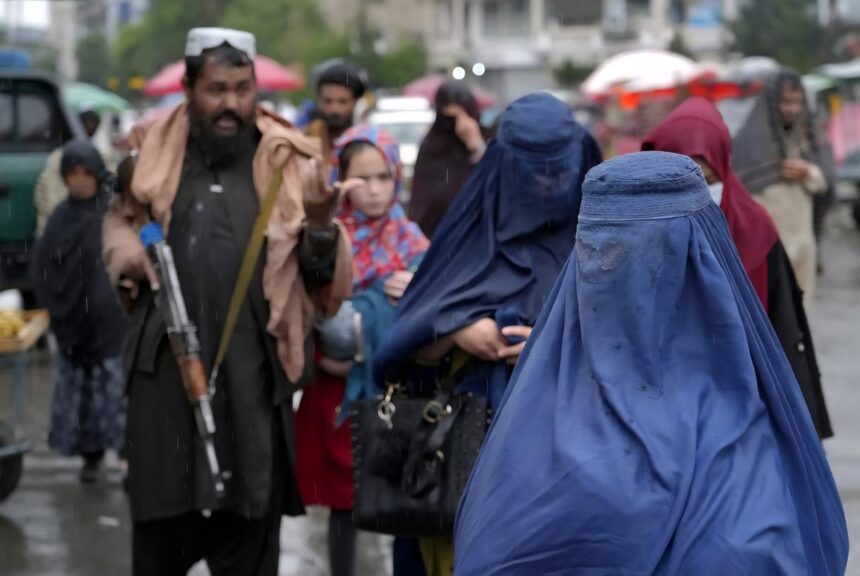
She explains that the outlet cited directives from the Taliban’s Ministry for the Promotion of Virtue and Prevention of Vice, requiring that any Afghanistani woman even those living abroad must appear fully covered, including face veiling, if featured in media. Analysts view this as a clear attempt by the Taliban to export restrictive norms beyond their territorial control and impose them on international media practices.
Abbasi emphasizes that under such conditions, Afghanistani women are not recognized as professionals, but rather reduced to their gender identity effectively erasing their voices from the public sphere. From a human rights perspective, this approach represents a discriminatory system that selectively restricts freedom of expression.
The report notes that nearly five years after the Taliban’s return to power, freedom of expression in Afghanistan has been severely curtailed. For women in particular, meaningful space has almost entirely disappeared. Girls are barred from education beyond the sixth grade, women face sweeping employment restrictions, and their participation in public life has been systematically dismantled. In some provinces, female journalists are banned from working altogether, and broadcasting women’s voices on radio and television has been prohibited.
Observers stress that these developments are no longer geographically limited. Through informal influence and pressure on media institutions, the Taliban are attempting to impose their rigid rules on Afghanistani women abroad signaling an expansion of their control mechanisms and a deepening pattern of structural repression.
Abbasi concludes by stating that, as an Afghanistani woman and researcher, she refuses to comply with such restrictive directives. However, she warns that these policies carry serious consequences for the fundamental right to free expression for Afghanistani women both inside and outside the country. According to her, women should not be forced to accept discriminatory conditions in order to exercise their basic right to speak publicly.