
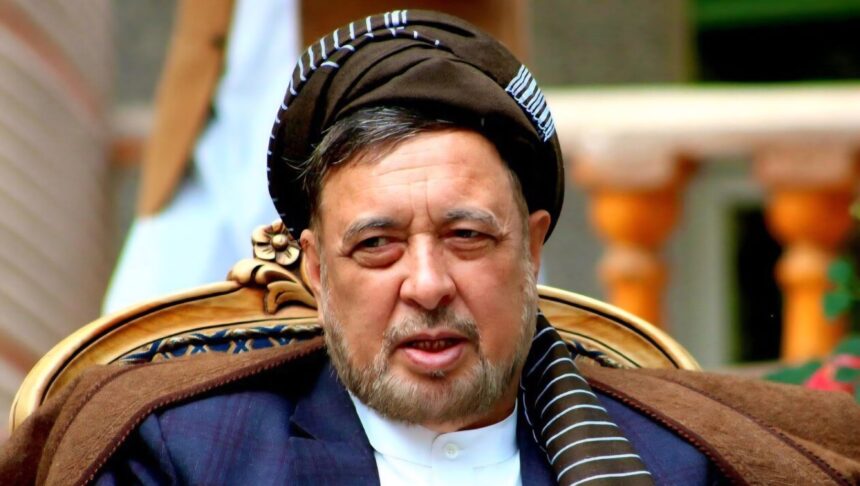
RASC News Agency: Mohammad Mohaqiq, a prominent opposition figure against the Taliban and member of the High Council of Resistance for the Salvation of Afghanistan, has stated that he recognizes the Durand Line as the official and internationally legitimate border between Afghanistan and Pakistan a position that stands in clear contrast to the Taliban’s stance.
In an interview with a private television channel, he emphasized that he supports internationally recognized borders established within the framework of international law and endorsed by the United Nations as Afghanistan’s official boundaries. Mohaqiq also warned that territorial claims could escalate regional tensions.
Referring to disputes between the Taliban and Pakistan over the Durand Line, he said the Taliban claim ownership over roughly 35% of Pakistan’s territory. He described this position as unrealistic and costly, adding:
“We are committed to the United Nations’ demarcation, and we do not support territorial claims against Pakistan; because if we go up to Attock, they will come up to Motaq.”
The leader stressed geopolitical realities in the region, calling Pakistan a nuclear power and stating that continued disputes would not benefit Afghanistan.
The Durand Line was drawn in 1893 during the rule of Amir Abdur Rahman Khan between Afghanistan and British India. Named after British diplomat Sir Mortimer Durand, it defined the boundary between the two sides. After Pakistan’s creation in 1947, it remained the de facto border between Afghanistan and Pakistan.
However, successive Afghanistan’s governments have not formally recognized it, making it a long-standing source of tension in Kabul–Islamabad relations.
Unlike Mohaqiq’s position, the Taliban currently ruling Kabul continue to reject recognition of the Durand Line and have repeatedly made territorial claims beyond it.
In this context, Taliban Defense Minister Mullah Yaqoob Mujahid previously claimed that one of Pakistan’s demands in talks with the group has been the formal recognition of the Durand Line.
Mohaqiq also revealed that he had raised this issue earlier with former Afghanistan’s President Hamid Karzai. According to him, during an official meeting with senior officials, he argued that rejecting the border was not in Afghanistan’s interest.
He metaphorically described Afghanistan’s geopolitical map as resembling a “mulberry leaf,” arguing that this limited territorial reality should be accepted as a practical framework.
Mohaqiq’s remarks highlight a deep political divide among Afghanistan’s factions over one of the country’s most sensitive geopolitical issues. While the Taliban maintain traditional and rigid positions, some opposition figures advocate alignment with international legal norms and reduced regional tensions.
Given the strategic importance of the Afghanistan–Pakistan border especially in security, trade, and regional stability any shift in official positions regarding the Durand Line could have significant implications for bilateral relations and broader regional dynamics.