
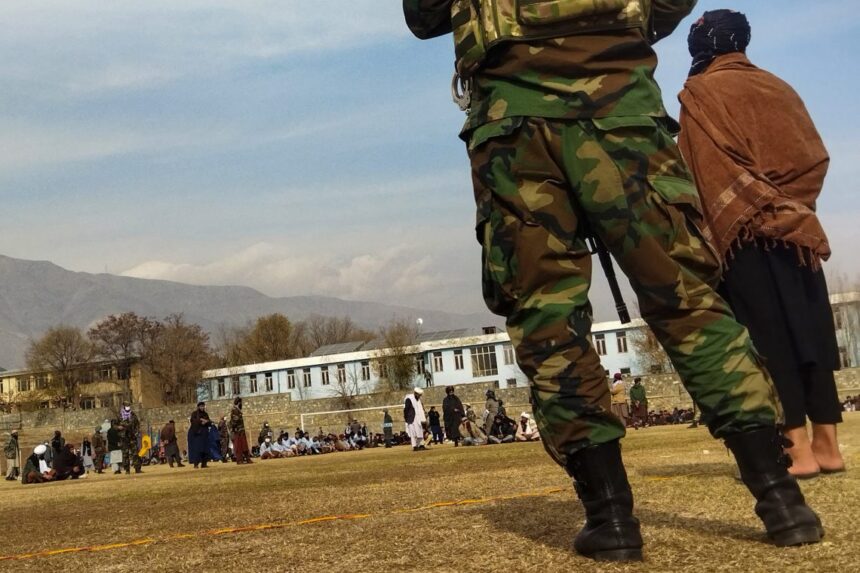
RASC News Agency: The Taliban’s Supreme Court has announced that its forces carried out the public flogging of 20 individuals, including two women, in the provinces of Herat, Kunduz, and Kunar, in two separate incidents an act that underscores the group’s continued reliance on corporal punishment as a central instrument of governance.
In the first case, eight individuals, among them one woman, were flogged in Herat and Kunar on unspecified charges. According to the Taliban’s statement, the punishments were approved by Taliban courts and executed in public, a practice that has become increasingly routine under the group’s rule.
In the second incident, 12 more people, including one woman, were flogged in Herat, Kunduz, and Kunar after being convicted of charges such as consumption and trafficking of alcohol, same-sex relations between men, theft, and what the Taliban describe as “illicit relationships.” Each individual received between 20 and 39 lashes and was additionally sentenced to prison terms ranging from two months to two years.
According to data compiled by Afghanistan and international media outlets, the Taliban have publicly flogged at least 808 people nationwide since the beginning of the current solar year (March 2025). This figure includes both women and men and reflects a sharp escalation in the use of corporal punishment, particularly in public settings.
Human rights organizations have repeatedly warned that the Taliban’s revival of public flogging, alongside other physical punishments, constitutes a clear violation of international human rights law, including the prohibition of torture and cruel, inhuman, or degrading treatment. These punishments are carried out through judicial processes that lack due process guarantees, independent legal representation, or transparent standards of evidence.
Beyond the physical harm inflicted, rights advocates emphasize the psychological and social impact of public punishments, which are deliberately designed to instill fear, enforce ideological conformity, and normalize violence as a tool of social control. Women, in particular, face compounded vulnerability, as corporal punishment is embedded within a broader system of gender-based repression that excludes them from education, employment, and public life.
The Taliban have consistently defended these practices as the implementation of their interpretation of Islamic law. However, international legal experts and Islamic scholars alike note that the group’s punitive system reflects a politicized and selective reading of religion, deployed to consolidate power rather than deliver justice.
As Afghanistan remains isolated diplomatically and engulfed in overlapping humanitarian and rights crises, the expanding use of public flogging further erodes any claim by the Taliban to legitimate or humane governance. Instead, it reinforces a pattern in which state power is exercised through fear, spectacle, and coercion, with ordinary citizens especially women and marginalized groups bearing the heaviest cost.