
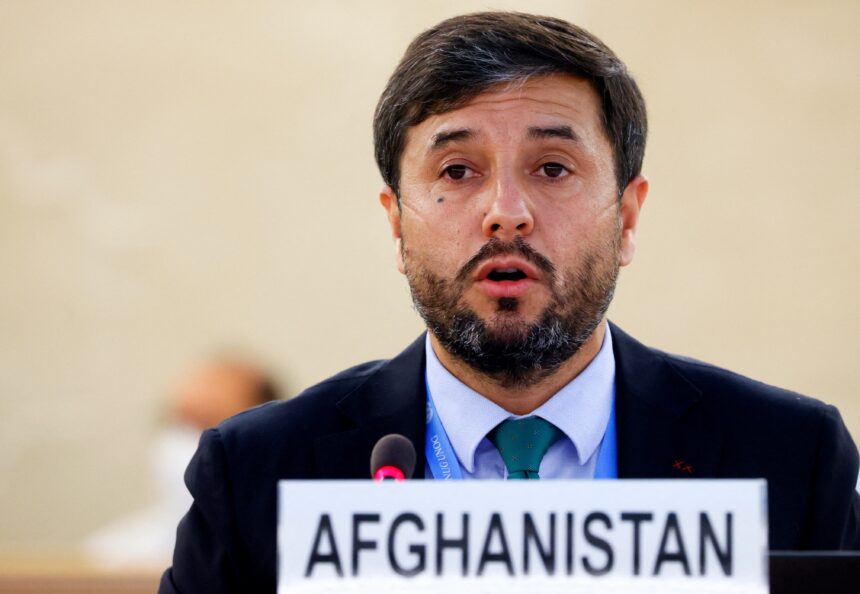
RASC News Agency: Nasir Ahmad Andisha, former Afghan diplomat and ex-representative to the United Nations Office in Geneva, has warned that Afghanistan under Taliban rule is facing not only political, human rights, and humanitarian crises, but also a profound existential and identity crisis that strikes at the very foundations of the nation.
In a statement published on the social media platform X (formerly Twitter), Andisha argues that nations are not built or sustained through the force of weapons, but through shared meanings, values, and the resilience of citizens who refuse to submit to injustice, oppression, and discrimination. From his perspective, the Taliban through their ideology and policies are systematically dismantling the cultural and symbolic pillars upon which Afghanistan’s national identity has historically rested.
Andisha emphasizes that throughout Afghanistan’s history, shared culture not politics has been the core binding force of the Afghanistani nation-state. This cultural fabric, he writes, has been shaped by traditions of hospitality, poetry and music, storytelling, respect for beauty, the celebration of Nowruz, the architectural heritage of mosques and fortresses, and a moderate, humane interpretation of Islam.
He warns that the Taliban’s bans on music, censorship of poetry, systematic exclusion of women from public life, restrictions on languages, and distortion of historical narratives represent a trajectory that threatens not merely cultural expression, but the very existence of the nation itself. In this context, Andisha rejects the notion of the Taliban as a “government of the people,” instead describing them as a force accelerating the fragmentation of Afghanistan as a shared national community.
According to Andisha, Taliban ideology is fundamentally incompatible with Afghanistan’s historical diversity ethnic, linguistic, cultural, and gender-based. He argues that the group is attempting to impose a rigid, monolithic, and exclusionary identity in place of this pluralism. Such a project, he notes, is not simply a political or social regression, but a deliberate severing of Afghanistan’s cultural roots.
He further observes that while previous authoritarian regimes failed despite repression to fully erase the nation’s cultural identity, the Taliban are targeting the “spirit of the nation-state” from within, weakening it at its core.
In a particularly pointed section of his remarks, Andisha criticizes intellectuals, journalists, and public figures who, he says, have knowingly or opportunistically aligned themselves with the Taliban. By providing intellectual or media legitimacy to Taliban rule, he argues, these individuals bear responsibility for inflicting deeper harm on the essence of Afghanistan, adding that their role will not be forgotten in the country’s collective memory.
Andisha concludes by stressing that Afghanistan’s survival depends on comprehensive resistance across all spheres of society, with the participation of all its people. The ultimate aim of this resistance, he says, is to preserve the soul of the nation and ensure Afghanistan’s continued existence as a state within the international community.
These remarks come at a time when Taliban-ruled Afghanistan remains mired in international isolation, economic collapse, sweeping restrictions on women, and the systematic suppression of civil liberties conditions that have intensified debates among Afghanistani intellectuals about the country’s national identity and social cohesion.