
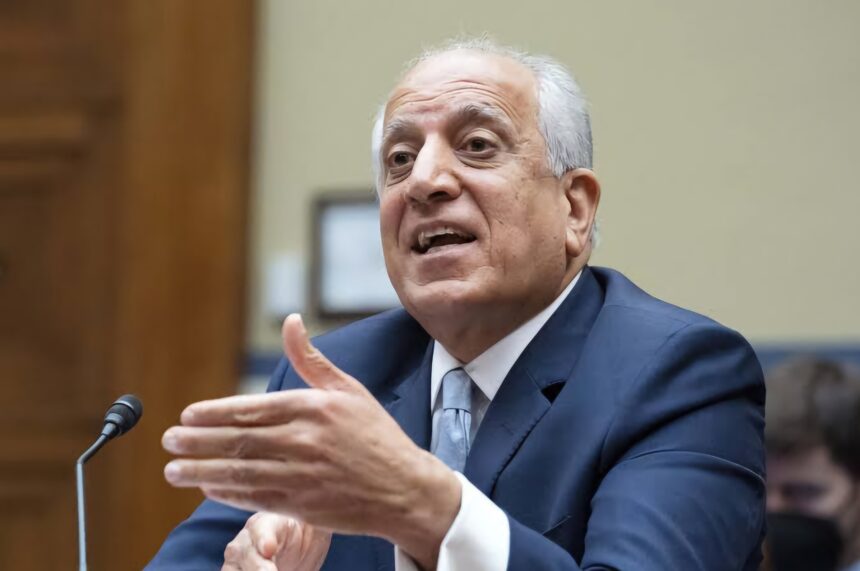
RASC News Agency: Zalmay Khalilzad, former U.S. Special Representative for Afghanistan and a central architect of the Doha Agreement, recently asserted that the Taliban are prepared to negotiate a bilateral security accord with Pakistan. The claim, however, is met with serious skepticism, given Khalilzad’s historic role in politically legitimizing the Taliban and the disastrous consequences of his past interventions.
Responding to remarks from a senior Pakistani official, Khalilzad acknowledged that the Doha Agreement between the U.S. and the Taliban did not formally address Afghanistan-Pakistan relations. Yet, he is now using this “gap” to propose a new initiative one he claims could transform relations between Kabul and Islamabad. Critics argue that this positions Khalilzad once again as a political engineer who, historically, made Afghanistan’s fate subject to high-cost, unaccountable decisions.
Khalilzad’s proposed agreement envisions commitments from the Taliban that no individual or group including ISIS and Tehrik-i-Taliban Pakistan (TTP) would use Afghanistani or Pakistani territory for cross-border attacks, with enforcement monitored by a third party. However, analysts highlight that Khalilzad previously upgraded the Taliban from a militant insurgency to a legitimate international actor without enforceable human rights guarantees or national consensus, directly facilitating the collapse of the Afghanistan’s Republic and the return of an authoritarian regime.
Khalilzad further claims that the Taliban leadership has expressed willingness to negotiate such an accord. Yet, since seizing power with political leverage derived indirectly from the Doha Agreement, the Taliban have consistently failed to honor security commitments and have transformed Afghanistan into one of the most closed and repressive political systems globally. Their historical tolerance of extremist groups raises serious doubts about the feasibility of any genuine security pact.
Afghanistani and international analysts assert that Khalilzad continues to present the Taliban as “negotiable” and “pragmatic”, a narrative that sharply contrasts with the on-the-ground reality: systematic repression of women, the banning of girls’ education, dismantling of civil and political institutions, and suppression of dissent.
In a concluding tweet, Khalilzad wrote that “the ball is in Pakistan’s court.” Observers argue that this framing shifts responsibility away from the principal architects of Afghanistan’s crisis and onto regional actors. In reality, until the Taliban evolve into a law-abiding, accountable, and internationally committed governance structure, no bilateral agreement, regardless of signatories, can guarantee sustainable security.
Khalilzad’s latest statements not only underscore his central role in legitimizing the Taliban but also reflect a persistent pattern: the Doha Agreement’s model crafted without safeguards or accountability appears poised for replication under a new guise. The ultimate cost, analysts warn, will again be borne by the Afghanistani people, especially women and the next generation.