

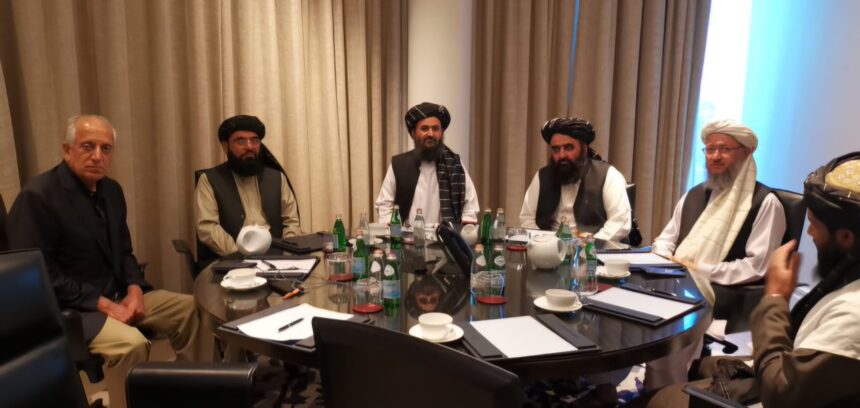
RASC News Agency: Recent remarks by Zalmay Khalilzad, the former U.S. Special Representative for Afghanistan, claiming that the Taliban have remained committed to the Doha Agreement have once again pushed the deal to the center of regional political and security controversy. In a sharp but evidence-based response, Jan Achakzai, former Information Minister of Pakistan’s Balochistan province, described Khalilzad’s account as a distortion of reality, fundamentally at odds with credible international assessments and on-the-ground developments.
In a statement published on the social media platform X, Achakzai referred directly to Khalilzad’s interview with TOLO News and his recent public positions. According to Achakzai, Khalilzad’s narrative appears designed to deflect responsibility for mounting security failures resulting from the Taliban’s non-compliance with counterterrorism commitments, shifting the burden instead onto regional actors particularly Pakistan. This, he argues, misrepresents the nature of the Doha Agreement, which was a strictly bilateral arrangement between the United States and the Taliban, not a regional security pact obligating neighboring states to reciprocal measures.
Achakzai further contended that one of the most serious flaws in Khalilzad’s narrative is the downplaying of authoritative United Nations assessments regarding the persistence of terrorist networks in Afghanistan. He cited the December report of the UN Analytical Support and Sanctions Monitoring Team, which documents the continued presence and operational capacity of multiple extremist groups on Afghanistan’s soil findings that directly contradict claims that the Taliban have severed ties with transnational terrorist organizations.
According to the former Pakistani official, criticism of Taliban non-compliance is not limited to Pakistan. Over recent years, lawmakers and oversight bodies in the United States have also openly stated that the Taliban have failed to uphold core provisions of the Doha Agreement, particularly the commitment to prevent Afghanistan’s territory from being used by international terrorist groups. In this context, Achakzai referenced remarks by Bill Huizenga, Chair of the U.S. House Subcommittee on South and Central Asia, who warned that Afghanistan is once again becoming a sanctuary for the reconstitution of extremist networks developments that pose a direct threat to regional and global security.
Achakzai also pointed to clear empirical evidence that undermines the Taliban’s claims. Among the most significant examples is the killing of al-Qaeda leader Ayman al-Zawahiri in Kabul in 2022, an incident that, in his assessment, alone calls into question assertions that the Taliban have fully severed relations with terrorist organizations. He further cited indications of the re-emergence of senior al-Qaeda figures, suggesting a sustained and structured presence of extremist networks within Afghanistan.
In contrast, Achakzai characterized Pakistan’s counterterrorism record as self-evident, emphasizing that Islamabad has conducted an extensive campaign against militant threats over the past two years despite substantial financial, human, and security costs. From this perspective, he argued, attempts to transfer responsibility for regional insecurity onto Pakistan are not only inconsistent with empirical data but also undermine the principle of accountability embedded at least nominally in the Doha Agreement itself.
This intensifying clash of narratives underscores a deeper reality: rather than serving as a durable framework for reducing terrorism, the Doha Agreement has increasingly become a political battleground over responsibility, blame, and narrative control. The consequences of this dispute extend far beyond rhetorical confrontation, directly shaping regional security dynamics and the future trajectory of Afghanistan where the gap between Taliban commitments and observable realities continues to widen.